
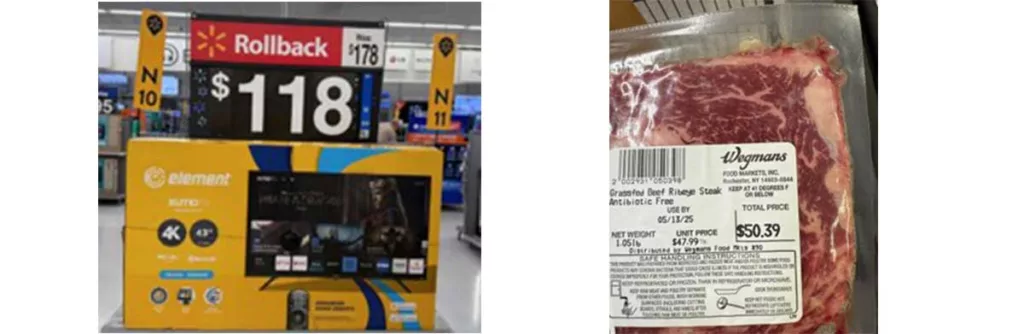
Recently, a relative gleefully sent through the pictures below to inform us that our upcoming US vacation would likely have a vegetarian slant, given the cost of buying steak. He further pointed out that for the price of two steaks, you could buy a decent-sized television.
At just R2 000/kg, you could be forgiven for thinking a Kobe-bred grass-fed, pasture-raised, clean as a whistle, smiling Wagyu was on the menu, not a lowly shop-bought ribeye. I didn’t point out that with the new tariffs, he had better act quickly, as his element 43” TV is sourced via China.
This interaction highlighted how currencies – in this case, the mighty dollar vs the lowly ZAR – can be a complicated part of investing, and nevertheless, he still bought the ribeye.
Yet currencies are incredibly important in determining your future wealth outcomes. Below, we outline the various ways in which currency factors into your investment world. Sometimes it is really critical, and at other times quite superficial. Without a guide of some sort, unanswered currency-related questions can often cause confusion and anxiety for investors.
Given that disclaimer, we will aim low in this case but reserve the right to extend the discussion in later articles once we have hopefully clarified the basics.
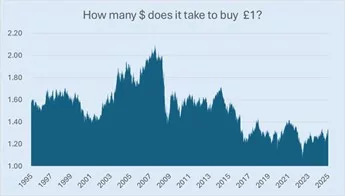
For context, its worth highlighting that if you had chosen GBP as your portfolio exposure (many do, given SA’s expat links) in 2007, today your investment on a pure currency basis would have lost almost 40% of its value should you measure it back to US$ (or travel and spend in the US for that matter). Similarly, we often feel like the Rand is weak against all currencies, yet it is actually not too bad vs GBP over the past decade (almost flat, meaning we have largely preserved our buying power in London for 10 years – Brexit hasn’t been helpful to them).
Often, we think about wealth in Rand and ‘not-Rand’ terms – implying that, provided we have our money out of Rands, it is safe1. In fact, it is far from safe, highlighted by this depreciation above between two so-called ‘hard’ currencies. Had you placed your investment in USD in 2001, you would be 50% underwater when measuring in GBP by 2008. Over any 10-year window for the past four decades, you would at times be up to 40% richer or poorer, just on the moves between these two ‘hard’ currencies. Practically, you feel it when you travel or spend in foreign currency, like the ribeye example above. Spending in a foreign currency crystallises the relative failure or success of your investment strategy.
On to the ways in which we come across currencies in investing. Below, we focus mainly on offshore portfolios, as this is where much of the complexity lies and is an increasingly large component of the domestic savings pool. Similar rules apply to SA portfolios, though. These are the six areas which need to be understood.
Table 1: Types of Currency Exposure within Investment Portfolios
| Where currency features in your portfolio | Does currency matter? | What are the Implications? | |
| 1. | Your source of funds (i.e. you are investing Rands, GBP or USD) | No | Many investors will start with what they have, usually Rands, GBP or USD. While this is a comfortable anchor to measure future outcomes, it shouldn’t really be the defining feature of your investment strategy. In some cases, your portfolio may require a 100% currency change; in other cases, no change. The currency you start with doesn’t automatically link to the currency where you need to be. |
| 2. | The currency you select to denominate and report your offshore investment account in | No | This is the so-called ‘reporting currency’. Many investors define their account reporting in terms of the source of funds they contributed to start. We often see this set as GBP, but where a USD portfolio has been selected – as investors feel more comfortable tracking GBP returns. Yet this causes complexity in assessing the returns, illustrated by the example above. For instance, the USD portfolio performance is good, but the USD weakens vs GBP (as it did from 2001). You would be asking serious questions of your investments at this stage (down 30-50% in GBP), yet the issue lies in the choice of reporting currency and portfolio selection, rather than the delivery of returns. Choosing the correct portfolio is the priority here, and then ideally using the relevant currency to assess returns. |
| 3. | Equity domicile vs operations | Mostly No | The fact that a company is listed in a certain stock market, like the JSE (ZAR), Nasdaq (USD) or FTSE (GBP), doesn’t mean that is the currency exposure you inherit. Rather, you get the mix of currencies based on where each company you invest in is operating. Tesla, for example, sells around half of its vehicles outside of the US, despite being listed there. Sometimes a company hedges its non-home sales and expenses back to its own home currency, but as a general rule, your currency exposure for a broad global equity holding is weighted to the developed market currencies (USD, Euro, Yen, Pound) as well as the emerging markets. If you select regional specific funds (like Emerging Markets, or S&P500), then your currency exposure does become a factor, but still quite diversified and not something you need to worry too much about. |
| 4. | Your choice of investment portfolio, from low to high risk | Yes | It does matter which investment option you select, as each has different underlying currency exposures. The rule of thumb is that the more conservative a portfolio is, the more you worry about your currency choice. For the most part, equity portfolios don’t require a conscious currency choice (as above), whereas income, conservative and balanced portfolios should. |
| 5. | Fund pricing currency | Sometimes | An offshore fund has a price that you buy and sell at, and a ‘base’ currency it reports in. That is quite often irrelevant to the actual currency exposure you get. For example, a USD-priced Emerging Markets fund gives you very little USD currency exposure. Similarly, a global equity fund priced in GBP, EUR, or USD will deliver virtually the same return, irrespective of which you pick. However, with the lower risk funds – cash, bonds and the like, the currency exposure is often directly linked to the pricing currency. |
| 6. | Your long-term goals | Yes | This is probably the biggest decider in your overall success. While we placed it at the end of our list, it will come right at the beginning of your financial planning. Setting short-, medium-, and long-term investment goals typically involves deciding which currency or group of currencies to build your wealth in, based on where your future spending lies – such as travel, property, education, children, and the like. If you are not planning on spending, then you are just looking for the currency or basket of currencies which will retain or grow their global buying power over time. |
We have skipped over many details here, but hopefully the core message comes through loud and clear: be careful with your currency choice! It shouldn’t be a legacy decision or a default choice.
Currently, we are in an interesting time, where the ‘exceptionalism’ of the US market and its dollar are being questioned. Will it remain the haven reserve currency forever, or will it be undermined – as it has been from time to time, through mismanagement or external crises? Investing for the long term is challenging when you also need to choose a currency or mix of currencies to grow your wealth, particularly when a new world order is being established. It was only 80 years ago when the Pound Sterling was the world’s primary reserve currency, and over the past 100 years it has lost over 70% vs USD2. The Chinese Renminbi may just make a move for this role in future, given their economic expansion and gradual relaxation of currency controls. How then would this impact portfolios? Refer to the table above!
Currency is notoriously difficult to assess within portfolios and is not an investment asset itself, but rather a barometer of a country’s economic health. This makes it an unreliable ally in long-term wealth creation. For our part, we maintain a broad perspective on currencies and aim to develop our knowledge of what will drive their value over the long term so that we can best structure client portfolios. Ultimately, though, the choice is yours as to where to build your wealth and which mix of currencies is ideal. Starting with an understanding of what matters – and what doesn’t – can be a useful input in the financial planning and decision-making process.
[1] Sidebar: When holding cash, Rand accounts typically pay a lot more interest than USD, EUR or GBP. So, while your currency is losing value, you can make up a lot of ground via higher interest income.
[2] https://www.exchangerates.org.uk
Article written by: Fundhouse – Discretionary Fund Manager